Tuesday, October 8, 2013

Kråka


The subject of the portrait is Aslaug, the reported daughter of Sigurd and the shieldmaiden Brynhildr, from Norse Mythology. The shadow of a wing falls across her visage to imply her moniker, Kråka (‘Crow’), given to her by a pair of peasants who discovered her orphaned and stolen away in a harp. They hid her beauty--a trait of nobility--by rubbing her in tar and adorning her shoulders in a long cape. 

Aslaug's dress of layered netting and shells refers to her battle of wits with the legendary Viking Ragnar Lodbrok, in which he challenges her to meet him “neither dressed nor undressed, hungry nor full and alone nor in company.” She arrives dressed in a net, biting an onion and with only a dog as a companion. Impressed by her ingenuity, Ragnar proposes marriage to her.

Available as a print at Canzine: Festival of Zines and Underground Culture--Sunday, October 20, 2013


Thursday, July 25, 2013

Greensight

"I'm Jojen Reed, this is my sister Meera. We've come a long way to find you, Brandon and we have much farther to go."

-Jojen Reed; Game of Thrones: Dark Wings, Dark Words (3.2)


Jojen and Meera Reed are the children of Howland Reed, Lord of Greywater Watch and loyal vassal of House Stark. Jojen was bestowed with greensight, the power of prophetic dreams, after being visited by the Three-eyed Raven in a near death experience. The velvet-voiced Thomas Brodie Sangster portrays the wiser-than-his-years Jojen to perfection on HBO's Game of Thrones, and as her brother's protector, Ellie Kendrick adds charm to Meera Reed.


Monday, June 17, 2013

A Man Has Said

“The Red God takes what is his, lovely girl. And only death may pay for life. You saved me and the two I was with. You stole three deaths from the Red God. We have to give them back. Speak three names and the man will do the rest. Three lives I will give you - no more, no less, and we're done.” 

George R.R. Martin, 'A Song of Ice and Fire: A Clash of Kings'


Monday, January 14, 2013

Queer Lodgings


“He is a skin-changer. He changes his skin: sometimes he is a huge black bear, sometimes he is a great strong black-haired man with huge arms and a great beard…Some say that he is a bear descended from the great and ancient bears of the mountains that lived there before the giants came. Others say he is a man descended from the first men who lived before Smaug or the other dragons came into this part of the world, and before goblins came into the hills out of the North. I cannot say, though I fancy the last is the true tale… I once saw him sitting all alone on the top of the Carrock at night watching the moon sinking towards the Misty Mountains, and I heard him growl in the tongue of bears: ‘The day will come when they will perish and I shall go back!’ That is why I believe he once came from the mountains himself”

-J.R.R. Tolkien, The Hobbit: Queer Lodgings

The imagery conjured by this passage has remained with me for nearly a year and a half. Countless projects have seen completion before this one, but ‘Beorn’ preceded them as a nearly polished idea in my subconscious. Despite its simplicity, illustrating the transfiguration of Beorn into a black bear was immensely challenging. The ambiguity of this ‘in-between’ stage was compensated for by fog and light. Intending for this to be more than portrait, I knew I had to introduce a conceptual element. I capitalized on the shapeshifter’s affinity for animals by encircling his body in an ethereal current made up of birds. Although Beorn had a particular love of bees, they didn’t translate as well from a visual standpoint. 

As this was an experiment of traditional and digital means of picture-making, constructive criticism is much appreciated :D

I am mightily excited for Swedish actor Mikael Persbrant's portrayal of Beorn in the second installment of Peter Jackson's The Hobbit trilogy, The Desolation of Smaug. Although I did not take visual cues from Persbrant in this portrait, the duality of his facial expressions recall the kindness and ferocity of a bear. Excellent casting choice. 

Thursday, November 1, 2012

Brave

A birthday gift inspired by Disney’s animated film, ‘Brave’ for one of my closest friends. The painting borrows from a scene where Merida and her bewitched mother are taking shelter in a dark grove. While the other slumbers, Merida lies awake in guilt and recalls happier times with her mother during childhood.

The lack of reference used in the overall painting distanced me from my traditional realism and brought out a whimsical quality that I might not have otherwise achieved. I’ll admit to avoiding moonlit environments where possible because of the change in visual perception. According to a recent scientific hypothesis, moonlight is not blue, but slightly redder than the average colour of direct sunlight. There is nothing in the interaction between the sun’s reflection on the surface of the moon to suggest the colour blue. Although the colour-receptive rods in the human eye are incapacitated by moonlight, scientific instruments have shown them to be most sensitive to greenish wavelengths of light. As a result, blue-green hues appear lighter in tone in dim conditions. The phenomenon is identified as the Purkinje Shift. It is different from, and often mistaken for, the perception of moonlight as blue. Despite adhering to the Purkinje Shift in my painting, Merida’s hair is still a fiery and brilliant red :)


Wednesday, July 11, 2012

Sunny Quail


Each year at the Toronto Outdoor Art Exhibition, artists voluntarily donate a 6” x 6” unique artwork to support the exhibition’s fundraising effort, Art Squares. I chose to create an illustration inspired by Foster the People’s uplifting concert at Downsview Park on June 19, 2012. Tuesday evening’s performance, featuring Foster the People and local openers Tokyo Police Club, went ahead despite a tragic stage collapse that occurred before a scheduled Radiohead concert the preceding weekend. I recall merging with the migrating crowd on a long stretch of road toward The Meadow when the wreckage came into view. An aura of sombreness and foreboding hovered over us all until greeted by the up-tempo beats, captivating lyrics and impressive light show of the concert’s double feature. Midway through Foster the People’s set, Mark Foster paid a touching tribute to the late Scott Johnson, a casualty of Saturday’s incident. “We make music to bring joy to people” Foster said poignantly as he went on to describe the bonds of friendship shared between a band and its crew members while touring. Foster the People and musical guest Kimbra continued their celebration of life in grand fashion and proved yet again that music is integral to the healing process.

Foster the People formed in Los Angeles and carry many Californian sensibilities. Accordingly, my decorative painting features the state’s national bird, The California Quail. The quail is widespread and appears in the mythology and legends of numerous cultures as a symbol for a contrite spirit, communal love, victory and the hunt. I always found it quite humorous that their call sounds as though it were exclaiming, “Run, Run Run” or “The man is coming, the man is coming!”.

The expressive anthropomorphic flower gestures at the animated sun the band featured in their main act. The mood of the piece was made to reflect the positive vibes the band’s music exudes.


Grad Show and Graduation


The weeks heralding our Grad Show on April 19 and 20 were charged with heavy emotion and anticipation. Late nights and early mornings were interchangeably spent finishing artwork and essays, conducting self-promotion initiatives and getting our grad show display underway. We survived the endurance test on our souls and creativity by encouraging one another and never losing sight of our goals. Thank you to everyone who has journeyed with me through these past four years :). You are exceptionally talented and wonderful people. I offer my heartfelt congratulations to all. Above all, I must acknowledge those professors who underwent much toil in preparing the graduate classes and coordinating the setup for our final exhibition.

The layout of my final display board and accordion on corner table.


 Family and friends on the first official night of our Grad Show.


Tuesday, July 10, 2012

Thesis Accordion


Although exceedingly late in commenting about the crowning events of my four years at Sheridan, namely Grad Show and Graduation, I would be more than pleased to share my sentiments with you in retrospect. I apologize to those followers who have been patient with my infrequent updates. The following half of the summer will guarantee plenty of creative progress as I prepare for FanExpo 2012.

The stretch of months between January and April of this year comprised alternating periods of conceptualisation, execution and revisions to my final thesis project. More than often they did not ensue in this order. I felt compelled to speed up my rendering process by turning to media outside acrylic and oil paints that could demonstrate similar painterly effects in a fraction of the time. I harnessed a method which combines the vibrant colour and effortless blending of soft pastel with tight brushwork in acrylic. With each piece this experimentation revealed more aspects of its character, ranging from cooperative to untameable. I eventually learned that acrylic and pastel can co-exist while occupying discrete areas on the same surface, only lightly infringing on each other’s territory. That and never throw gouache into the same mix. The latter is what led to obliterating thick layers of water and sky by means of industrial sandpaper. 

Eight of my thesis paintings were completed by this method and later compiled in an accordion book under the series title, The Sleepers.

Finding a printing bureau that could manufacture a one-off 11” x 72” accordion at a decent price and quality was no small feat. Then again, this is one of several cases where an artist’s vision is incompatible with the harsh practicality of reality. Thankfully in the final weeks before my graduation exhibition, a company called Global Printing Enterprises took on the challenge and excelled magnificently. The cover was created by refurnishing an old children’s book and applying a faux leather bind. Here are the results :)


Interior of  “The Sleepers”. A full length 72” accordion opens on the right hand side.


 Those “King Under Mountain” historical and fictional characters eliminated from the greater body of my thesis appeared as cartoons in the inside cover.


Wednesday, May 16, 2012

Redbeard


The completed Frederick I Barbarossa, Holy Roman Emperor (A.D.1122-1190). I am actually quite pleased with how this piece in the series turned out.

Toell the Great (Suur Tõll)


Toell the Great (Suur Tõll) in Estonian mythology is a great giant hero who lived and ruled as king on the Baltic Sea island of Saaremaa (Ösel). In Tõlluste village he made his dwelling place as a modest farmer who was in the habit of tossing large rocks at his archenemy Vanatühi or other enemies of the Saaremaa people. He was reportedly so tall that he would walk the distance to the neighbouring island Hiiumaa (Dagö) in easy stride. His walking stick was a 5 fathoms spruce trunk. Toell's life came to an abrupt end when an opposing giant decapitated him in a confrontation with invading Danish hordes. His body, headless and transformed into wood, grasped the foe and annihilated him before taking hold of his own head, impaling it on a sword and walking to his grave. Upon his death, Toell gave a solemn vow to rise from the dead and help his people in case of war. insolent children, however, mocked his promise by circling his resting place and yelling aloud, "Toell, Toell wake up, there is a war in the yard!." Toell rose, gerw angry with them for their trickery and returned to his grave swearing never to return. These circumstances render Toell the Great as an anti-King Under Mountain hero.


The giant's story is celebrated in the 1980 Soviet-era film, Suur Tõll. The full animation can be seen here.


Monday, March 5, 2012

Oedipus Rex


Portrayal of the tragic figure Oedipus Rex from Sophocles' Greek tragedy, "Oedipus Rex"; Created as part of a collaborative show for my freelance internship this past summer.

Bolesław I Chrobry

Bolesław I Chrobry or Bolesław I the Brave (967-1025) was Duke of Poland from 992-1025 and the first King of Poland from 1025 until his death. As firstborn child to the revered Miesko I, the first historical ruler of the Piast dynasty, Bolesław's remarkable tact as a politician, strategist and statesman elevated Poland into the pantheon of Europe's elite. The first crude effigy of the Polish White Eagle, the emblem of the Piast dynasty, can be found on the first crowned king of Poland's silver denarius.

Month of March

A hand-painted mosaic calendar portraying Mars, the Roman god of war and agriculture.

Wednesday, February 29, 2012

Kukai (Kōbō-Daishi)

Kukai (Kōbō-Daishi) was a 9th century Japanese monk, civil servant, scholar, poet, artist and founder of the Shingon or 'True Word' school of Buddhism. According to Japanese folklore, he is not dead, but 'meditating' beneath Mount Koya, awaiting the coming of Maitreya. Kukai's followers deliver him nourishment and a change of clothes daily, and a massive cemetery has sprung around his resting place.

This fifth piece in my King Under Mountain series was perhaps the most enjoyable to make, as it was rendered entirely in pastel. Despite the trickiness of the medium, it yields beautiful effects with enough patient experimentation.

Le Morte d'Arthur

"His life was gentle; and the elements 
So mix'd in him that Nature might stand up 
And say to all the world, This was a man!"
William Shakespeare, Julius Caesar Scene V


King Arthur (Arthur Pendragon) is a legendary British leader of the late 5th and 6th centuries who led the defense against Saxon invaders in the early 6th century. The fine points of Arthur's tale have been gleaned mainly from folklore and literary convention, and his sparse historical background from various posthumous sources including the Historia Brittonum and the writings of Gildas. As he and his warriors prepared to march on Rome after a series of conquests in Norway, Denmark and Gaul, Arthur heard word that his nephew Mordred, whom he left in charge of Britain in his absence, had seized his throne and married his wife Guinevere. Arthur returned hastily to Britain, defeated and killed Mordred on the river Camlan in Cornwall but sustained mortal injuries of his own. On his deathbed, he bequeathed his crown to his kinsman Constantine and was taken to the isle of Avalon to be healed. From this point the Arthurian legend curtails for he was never seen or heard from again. Local folktale sources claim that Arthur and his Knights of the Round Table currently reside in a remote mountain dwelling, sleeping until the hour of Britain's greatest need.

In nearly all of my thesis pieces, I have used a common visual motif where nature encroaches on man or the long-time sleeper. For the sixth painting in my King Under Mountain series, I capitalized on the watery element of Arthur's katabasis or symbolic journey toward death in Avalon.


Wednesday, January 18, 2012

Old Falka and the Sleeping Giants

A three page narrative that tells the Polish legend of the unknowing blacksmith Falka and the mysterious stranger who leads him through the valley of Koscielisko to a high mountain peak where King Bolesław I Chobry and his knights are slumbering. Segments of the original tale have been included in the text of each illustration. Read the full account of the legend here.


Merry Christmas and Happy New Year!

I decided to handcraft Christmas ornaments as gifts for close friends this year. Owing to my extreme fondness for matryoshka dolls, I initially intended to create a Nativity scene of Russian doll tree ornaments and gift these individually. Unfortunately, I was unable to find the appropriate shape in pre-made wooden crafts so I had to settle with wooden eggs and flat ovals. I had a great deal of fun painting these and exploring the graphic sensibilities of each character design. The Nativity as portrayed here consists of the Virgin Mary and Baby Jesus, a Magi, St. Joseph and Archangel Gabriel.


Tuesday, January 17, 2012

Freelance Business Project

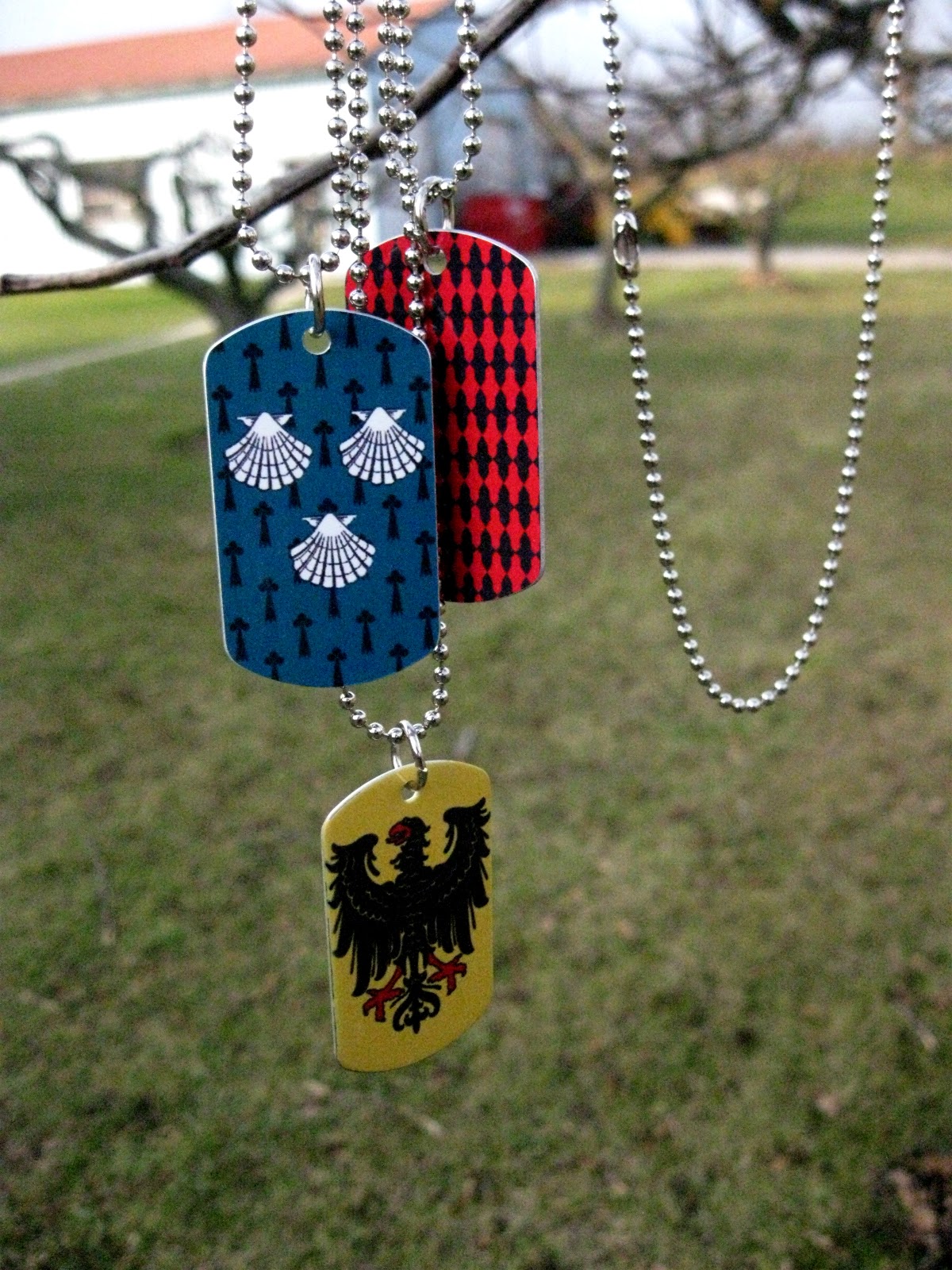
As part of our fourth year business class, our professor assigned us a semester-long project that required us to become entrepreneurial thinkers and build upon our knowledge of effectual advertising. We were asked to create a merchandise line that would highlight the use of our illustrations, Our business venture was geared toward promoting our work in an entertaining and functional manner. I chose to expand upon my increasing interest in English heraldry by fashioning a line of men and women's jewelery that features the decorative families of furs, portents and vairs. These simple and attractive patterns have made their way onto military dog-tags and circular lozenges, housed within a gossamer bag with a full description of the historical emblem's design. While a few represented existing coat-of-arms or national charges, including Richard the Lionheart's and the Polish, German and Byzantine eagles, the remainder were combined tinctures.


Sunday, December 4, 2011

Frankenstein and the Sublime

Illustrations produced for my Illustrations of the Romantic Period elective course which feature key plot events from Mary Shelley's groundbreaking Frankenstein or The Modern Prometheus (1819). These images intend to showcase fundamental elements of the Sublime as stipulated by political theorist and philosopher Edmund Burke (1729-1797) in his prose A Philosophical Enquiry into the Origin of Our Ideas of the Sublime and Beautiful (1756). The imagination, Burke correctly asserts, is activated by a sensation of awe and instilled with a degree of horror by what is "dark, uncertain, and confused".


Image #1: Victor Frankenstein catches a glimpse of the wretch near the location of William’s murder.

“While I watched the tempest, so beautiful yet terrific, I wandered on with a hasty step…I perceived in the gloom a figure which stole from behind a clump of trees near me. I stood fixed, gazing intently; I could not be mistaken. A flash of lightning illuminated the object and discovered its shape plainly to me; its gigantic stature, and the deformity of its aspect, more hideous than belongs to humanity, instantly informed me that it was the wretch, the filthy daemon to whom I had given life”
Frankenstein or, The Modern Prometheus, Chapter 7


Image #2: Murder of Elizabeth in her bridal bier.

Passage: “She was there, lifeless and inanimate, thrown across the bed, her head hanging down and her pale and distorted features half covered by her hair. Everywhere I turn I see the same figure—her bloodless arms and relaxed form flung by the murderer on its bridal bier” Frankenstein or, The Modern Prometheus, Chapter 23


Image #3: Discovery of Henry Clerval’s corpse

Passage: “As he was proceeding along the sands, he struck his foot against something and fell at his length on the ground. His companions came up to assist him, and by the light of their lantern they found that he had fallen on the body of a man, who was to all appearance dead. The supposition was that it was the corpse of some person who had been drowned and was thrown on shore by the waves; but, on examination they found that the clothes were not wet and even that the body was not then cold”
Frankenstein or, The Modern Prometheus, Chapter 21


Wednesday, November 23, 2011

Bran the Blessed

Owing to the demands of my first semester in fourth year Illustration, many of you have surely taken notice of my online disappearance and the deficiency of blog output...But, I have triumphantly returned to acquaint your eyes with the fruit of my toil :D.

A renown giant and king of Britain in Welsh folklore, Bran the Blessed’s (WelshBendigeidfran, literally "Blessed Raven", also Brân Fendigaidd live severed head was buried at his behest under the White Tower in London, facing France. The head served as a powerful talisman, protecting Britain from invasion for countless generations before it was excavated and turned around by the pious King Arthur, who claimed that from that point forward, Britain would be safeguarded by God and his armies alone.

In the Welsh tale of Bran the Blessed’s sister Branwen, Bran dispatches a formidable army to avenge the Irish king Matholwch’s maltreatment of his beloved sibling. The king’s swineherd witness their movements on the open sea and consult their queen:

“Hail to your Lordship!’ said they. ‘We have seen a forest on the ocean, where we never before saw a single tree…we see a great mountain beside the forest, and it is moving; and a high ridge on the mountain with a lake on each side of the ridge; and the forest and the mountain and the rest are all in motion.”
Upon hearing this, Branwen decodes the cryptic display,
“I know what this is. The men of the Island of the Mighty are coming over, for they have heard of my being punished and dishonoured”
‘And what was the mountain which they saw beside the ships?’ said they.
‘That was my brother, Bran the Blessed,’ she said. ‘wading through the shallows. There was no ship that could carry him’.
‘What was the high ridge with a lake on each side?’

‘That was he, looking upon this island,’said she, ‘for he is angry. His eyes on each side of his nose are the two lakes on each side of the ridge’

Bran’s love, which assumed a degree so powerful that both the forces of nature and man were summoned to preserve it, inspired this serene portrait. The giant’s mild expression and glistening eyes imply wisdom, his smile a hint of mischief. The horizon line is marked by the presence of the White Cliffs of Dover which served as Britain’s natural defense against aggressors crossing the English Channel. Bran represents the perfect confluence of dormant and active energies--the stationary monolith rising from the channel in a mantle of evanescent fog, the viking horde ascending the cliff tops. I will likely continue in this vein for the remainder of the series.


Initial concepts for Bran the Blessed, which gave greater focus to the 'severed head' notion than was perhaps acceptable. The intent here is that these images will appeal to adults and children alike.